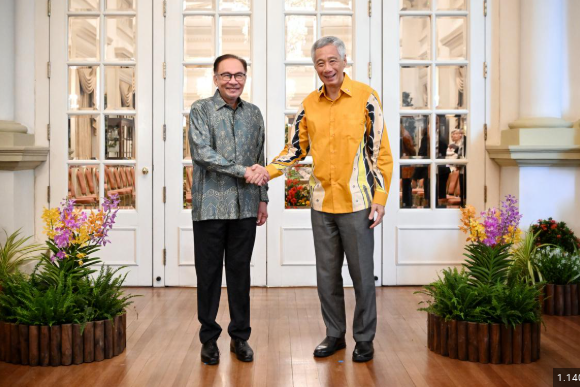
An agreement to establish a Special Economic Zone aims to boost trade and improve cross-border movement.
Singapore and Malaysia Set to Sign MOU for Johor-Singapore Special Economic Zone
SINGAPORE — Prime Ministers Lee Hsien Loong of Singapore and Anwar Ibrahim of Malaysia announced that both nations are working towards signing a Memorandum of Understanding (MOU) for the Johor-Singapore Special Economic Zone by January 11, 2024. This economic zone aims to enhance the flow of goods and people between the two countries, as well as strengthen the Iskandar Development Region in Malaysia and Singapore’s economy.
During the 10th Singapore-Malaysia Leaders’ Retreat, both leaders discussed key initiatives to move the project forward. PM Lee noted that a feasibility study is ongoing to determine the focus areas of the zone, including identifying market demand and investor interest. The project may include special tax arrangements and other initiatives designed to facilitate smoother trade across borders.
Additionally, there will be measures to make it easier for people who work on both sides of the Causeway, allowing companies within the zone to access the appropriate personnel from both countries. PM Lee emphasized that after the feasibility study, discussions will lead to the finalization of the MOU.
The two leaders also stressed the importance of strengthening bilateral economic ties, with Singapore and Malaysia being each other’s second-largest trading partners. Singapore has been a major investor in Malaysia, particularly in 2023, contributing to strong economic cooperation.
Both leaders further discussed cooperation in renewable energy, especially the possibility of cross-border electricity trading, and made progress on reducing congestion at the Woodlands Checkpoint and improving land connectivity. The completion of the Rapid Transit System (RTS) link by 2026 will also provide faster travel between Johor Bahru and Singapore.
PM Lee and PM Anwar agreed that key issues, including water supply from Johor to Singapore and maritime delimitation, should be addressed constructively, within the broader scope of their strong and growing partnership.