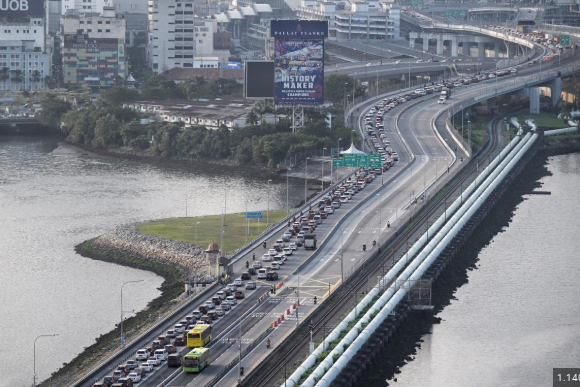
Efforts to enhance the flow of traffic between Singapore and Malaysia, including redevelopment of Woodlands Checkpoint, are progressing.
Singapore and Malaysia Collaborate to Ease Causeway Traffic Bottleneck
SINGAPORE — Prime Minister Lee Hsien Loong of Singapore and his Malaysian counterpart Anwar Ibrahim have highlighted that progress is being made to address the congestion at the Woodlands Causeway — a critical crossing between Singapore and Malaysia. These efforts are part of a broader initiative to increase the capacity of both countries’ land checkpoints, especially the Woodlands Checkpoint, which is undergoing redevelopment to improve clearance efficiency.
The redevelopment of Woodlands Checkpoint, including land reclamation, aims to significantly improve the flow-through rate for travellers, with plans to handle the increasing demand over the coming decades. PM Lee also noted that, alongside this project, the Johor Bahru-Singapore Rapid Transit System (RTS) is on track for completion by end-2026, which will further ease the flow of people across the border.
Both countries are working closely to optimize the capacity of the Causeway. PM Lee pointed out that the Immigration and Checkpoints Authority (ICA) in Singapore has introduced initiatives to streamline cross-border travel without compromising security. Furthermore, longer-term solutions include expanding the Woodlands Checkpoint to accommodate the projected 40% increase in traffic volume by 2050.
PM Anwar acknowledged that the congestion had been a major issue for workers, but also mentioned that the situation had significantly improved. The RTS Link, once completed, will provide a rapid and efficient connection between Bukit Chagar in Johor Bahru and Woodlands North, reducing travel time to just five minutes.
This collaboration emphasizes the shared commitment of both countries to improve cross-border connectivity, making it easier for Malaysian workers to travel into Singapore and vice versa. The RTS Link and the expansion of the Woodlands Checkpoint are expected to be key to resolving these traffic bottlenecks.